

You're in the kitchen, a freshly bought bag of specialty coffee in your hand. A glance at the label tells you the roast, the country of origin, and the flavor notes. You'll often also find the exact origin of the beans there. But why does one coffee come from a "Fazenda", the next from a "Finca", and yet another from a "Garden" or a "Washing Station"?
Isn't it all just another word for coffee farm?
The answer is: yes and no. While all these terms describe places where coffee is grown or processed, they are much more than mere translations into the respective local language. Behind each of these names lies the unique cultivation structure, history, and coffee culture of the respective region.
If you know the differences, you'll not only better understand the label on your coffee bag. You'll also immediately have a clear picture in your mind of the conditions under which your beans grew – from small family farmers to huge, structured cultivation areas.
In this article, we'll take a look at the ABC of coffee farms together.
Fazendas: The Giants from Brazil
If you read the word "Fazenda" on your coffee packaging, the coffee most likely comes from Brazil. The term originates from Portuguese and is the hallmark for coffee farms in the country where most coffee is grown.

Newly planted, small coffee bushes on Fazenda Guariroba in Brazil.
Endless rows of coffee bushes adorn the landscape, precisely planted across gentle hills that are not too steep, allowing for smooth machine harvesting. Fazendas are usually huge operations and are characterized by the following features.

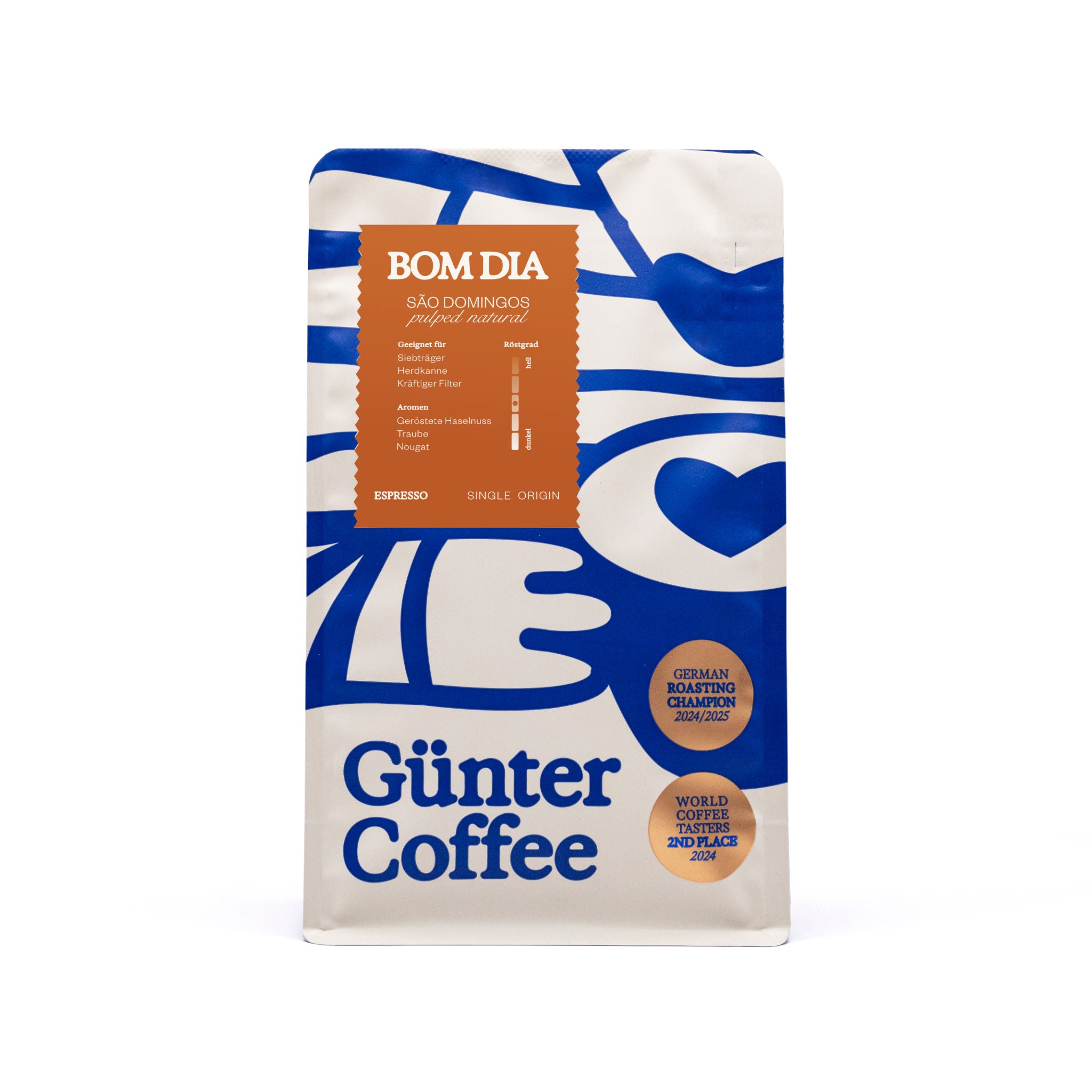
We taste Grape, Nougat und Roasted Hazelnut. What do you taste?
Try our BOM DIA Espresso.



Size and Structure: Fazendas often encompass hundreds or even thousands of hectares of land. Everything here is geared towards efficiency and consistent quality.
The Harvest: Due to the flatter topography and the sheer size of the plantations, mechanical harvesting is frequently used in Brazil. Alternatively, "stripping" is applied, where all cherries from a branch are stripped off with one hand movement. Of course, neither of these is always true. Even in Brazil, harvesting is done by hand here and there, but that is more the exception.
The Profile in the Cup: Coffees from Brazilian Fazendas often form the backbone of first-class espresso blends thanks to their round, low-acid profile. You will often taste distinct notes of chocolate, nut, and caramel here. We source many of our Brazilian coffee beans through Luis and Niklas from Ocafi, whom Mats visited in Brazil in 2022 to get an impression of coffee cultivation.
Fincas: Craftsmanship and Tradition in Central and South America
If you look at the map towards Spanish-speaking growing countries like Colombia, Costa Rica, Honduras, or Guatemala, the name changes: here they speak of a "Finca." A Finca often has a completely different atmosphere. Instead of endless plains, you'll frequently find these farms on steep mountain slopes, nestled in lush nature. This brings completely different conditions for coffee cultivation.

On Finca San Luis in Colombia, many coffee bushes grow on steep slopes.
Size and Structure: Fincas are generally significantly smaller than Fazendas. They are often family-run businesses that pass on knowledge about coffee cultivation and plant care from generation to generation. For example, Omar on Finca San Luis in Colombia, which Philip Weller visited during his coffee trip to Colombia in 2023. Many of these family fincas in countries like Peru, Honduras, or Colombia form cooperatives. Through this collaboration, they pool their resources, invest in shared processing facilities, and can thus position their coffee better and more fairly on the world market.
The Harvest: Where machines fail on steep slopes, manual labor is required. On fincas, harvesting is usually done selectively by hand (called "picking"). During harvest season, pickers go through the rows several times and selectively harvest only the deep red or yellow, perfectly ripe coffee cherries. If you want to know more about how this works and what other methods there are, check out our detailed article on coffee harvesting.
The Profile in the Cup: The extreme altitudes and winding mountain regions create unique microclimates. The result is coffees that shine with complex, fruity, and floral profiles with a bright, fine acidity. The detailed manual labor on the fincas allows for precise traceability. This means that specific coffee batches from a particular mountain slope or a single harvest day can be processed separately. The result is so-called micro-lots: absolute top-quality coffees that bring the pure character of their microclimate directly into your cup.
Gardens and Washing Stations: The Cooperative System in Africa
When you buy coffees from African countries like Ethiopia, Kenya, or Rwanda, you'll often search in vain for the term "farm" on the label. Instead, you'll read the names of Washing Stations or cooperatives. Why is that?

Washing Station Ayla Bombe in Ethiopia. Here, coffee cherries from hundreds of small farms are processed.
Size and Structure: Coffee cultivation here is largely in the hands of countless smallholders. They literally cultivate coffee bushes in their own gardens, often in healthy mixed cultivation directly alongside banana plants and other shade-giving trees. Philip Weller traveled to Ethiopia in 2024 with a small group of roasters. You can read the travelogue here.
The Harvest: Since the harvest quantities from a single garden would be far too small to operate their own processing machines, farmers bring their freshly picked cherries to the local washing station. There, it is decided how the coffee will be processed: whether "washed," "natural," "honey," or entirely differently. Our article on coffee processing provides a deep insight into these processes. The term "Washing Station" is mainly used in Ethiopia, while in Kenya, "Factory" is more common.
The Profile in the Cup: At the station, coffees from hundreds of different gardens in the immediate vicinity are collected, carefully sorted, and processed. African coffees are world-renowned for their tea-like, incredibly fruity, and floral notes, which are the result of this small-scale, meticulous garden work.
Estates: The Historical Legacy in Asia
A short trip to Asia reveals the meaning of the term Estate. If your beans come from India or Papua New Guinea, chances are high that you'll find this very word on the packaging.
Size and Structure: The term originates from the British colonial era and generally refers to larger, professionally managed agricultural properties.
The Harvest: Unlike African smallholders, estates usually have the necessary infrastructure not only to grow coffee on a large scale but also to process and export it directly on their own premises.
The Profile in the Cup: It is difficult to determine a typical flavor profile for coffee beans from Asia. This is partly because robusta is mainly grown in India and Vietnam, for example. On the other hand, it is also due to the fact that various colonial powers introduced different coffee plant varieties. In addition, there are varieties in Indonesia, for example, that are not found elsewhere.
A World in Your Cup
Finca, Fazenda, Garden or Estate – all these terms are much more than just local vocabulary. They tell the story of the people who grow the coffee, reveal details about the topography of the region, and give us a first subtle hint of what to expect in terms of taste in the cup. Behind each word lies a unique philosophy and coffee culture that is worth discovering. The terminology is no longer universally assignable to a specific country or region; there are also coffee farms in South America that bear the name "Estate," just as there are fincas not only in South America. Nevertheless, this classification is largely helpful when it comes to determining the origin of a coffee.
Now it's your turn: Grab your current coffee bag. Where do your beans come from, and what is the name of the farm or processing station on it? Let us know in the comments, we're curious about your discoveries!
We taste Grape, Nougat und Roasted Hazelnut. What do you taste?
Try our BOM DIA Espresso.