

You know the drill: We pick up a new hobby, watch a few tutorials, and before we know it, we're deep down the rabbit hole. Suddenly, we're casually throwing around acronyms that sound like a foreign language to friends and family.
The world of Specialty Coffee is notorious for this. All we wanted was to get more out of our morning coffee, and suddenly the internet is explaining extraction yield, PID controllers, and flat versus conical burrs. But if you've ever looked into how to improve your home coffee setup, you've almost certainly come across two of the most well-known acronyms: RDT and WDT.
Sounds like highly complex technology? Maybe, but in fact, they are very simple and, above all, inexpensive tricks that solve two of the most annoying problems in coffee brewing: messy countertops and unpredictable taste.
Before we dive in, let's briefly clarify whether this is even relevant to you.
If you only brew filter coffee (pour-over, drip machine, French Press): Definitely check out the RDT section. It helps with static and keeps your grinder clean. You can completely ignore WDT, however.
If you brew espresso: Both RDT and WDT will most likely become an integral part of your daily workflow.
Let's get started. In the following, we'll explain how a small splash of water and fine needles can improve your coffee ritual.
RDT (Ross Droplet Technique): Getting Static Under Control
If you've ever seen freshly ground coffee sticking to the walls of the dosing cup, flying through the air, and clinging to your countertop like iron filings to a magnet, you know the problem RDT solves.
When coffee beans are ground at high speed between the burrs of your grinder, a lot of friction is created. This friction generates static electricity. This problem is particularly pronounced in very dry air, for example in winter, or if you use a grinder with many plastic parts. This not only causes chaos in the kitchen but also leads to retention – meaning a gram or two of your expensive specialty coffee gets stuck in the grinder instead of ending up in your cup.

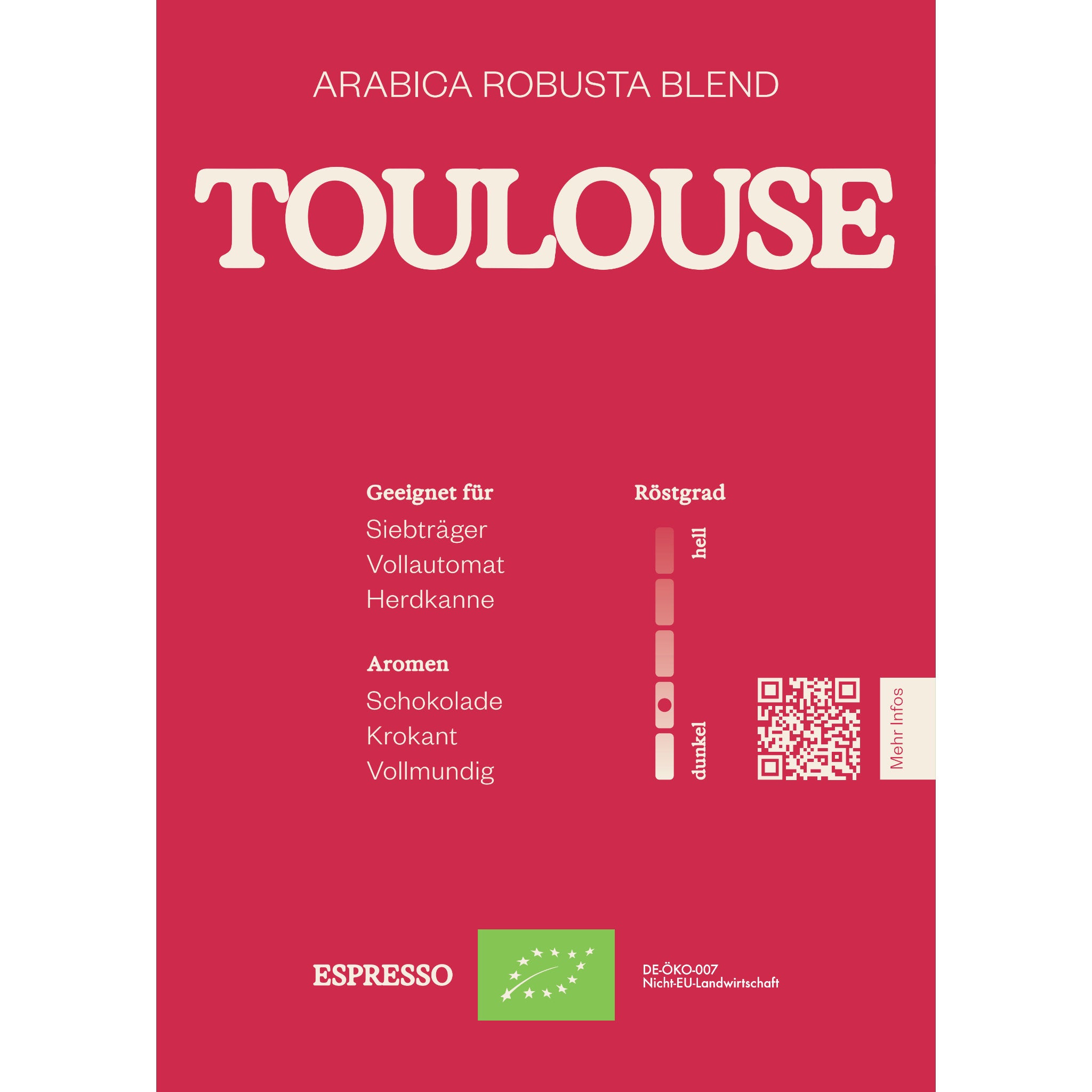
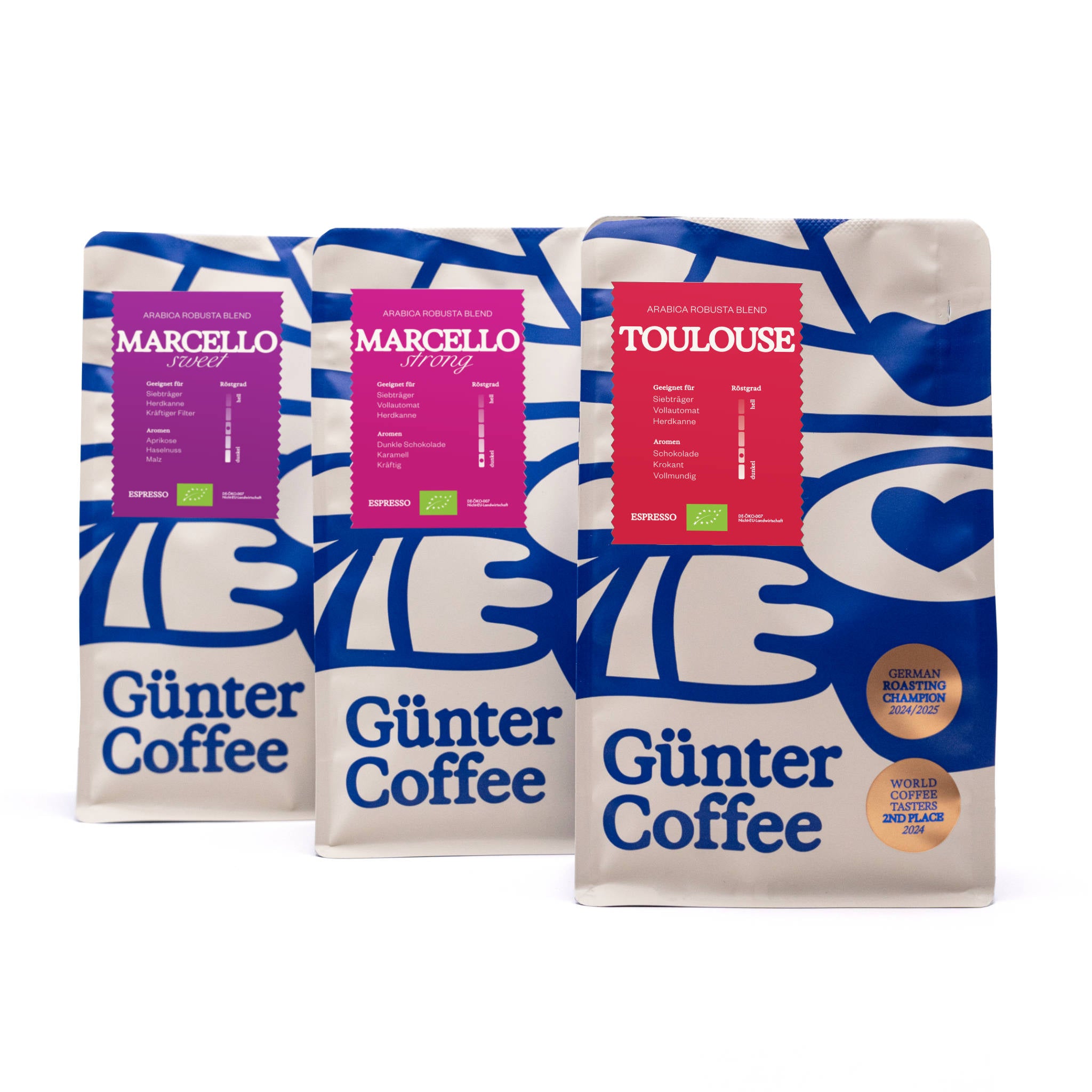
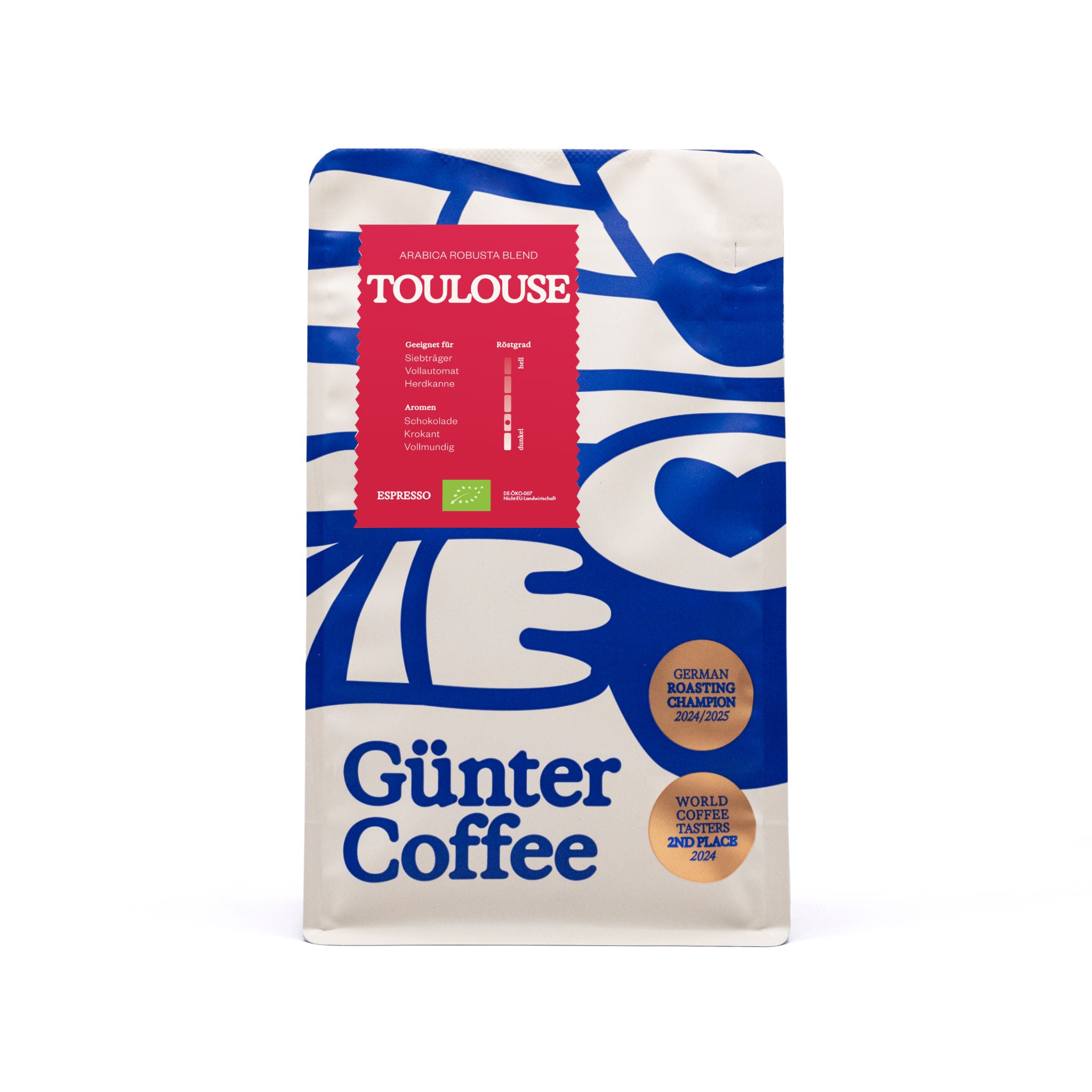
We taste Schokolade, Brittle und Full-bodied. What do you taste?
Try our TOULOUSE Blend Organic.


A quick note on modern grinder technology
Before we get to the manual solution, it's worth noting that grinder manufacturers are now taking our collective frustration quite seriously. In recent years, there has been a clear trend towards grinders with built-in anti-static properties. For example:
- Fellow Ode Gen 2: This popular filter coffee grinder was designed with a newly constructed chute including anti-static technology to eliminate the notorious mess of the first generation.
- Turin DF64 Gen 2: This powerful single-dosing grinder even has a built-in "Plasma Generator" (i.e., an ionizer) in the chute, which actively releases ions as the grinds fall out to neutralize static charge.
- Eureka Mignon Series: These popular espresso grinders rely on Eureka's "ACE System" (Anti-Clumps & Electrostaticity), which is designed to specifically prevent static cling and clumping.
If you have one of these newer, technically sophisticated grinders, static electricity might already be well under control. If not – or if you live in a particularly dry climate where even good technology reaches its limits – then RDT comes into play.
Tip: Over time, the anti-static properties of the grinder can diminish. Then it's time to clean your coffee grinder! If the static discharge parts are coated with coffee, they often no longer function properly.
Now comes RDT. Named after David Ross, the home barista who popularized the method on coffee forums in 2005, the Ross Droplet Technique sounds like a complicated laboratory procedure. In reality, it just means adding a tiny amount of water to the beans before grinding.
Water is extremely effective at dissipating static charge. By providing your whole beans with just a microscopically small touch of moisture immediately before grinding, you practically discharge the electrostatic charge. The result is fantastic: your coffee comes out cleanly from the chute, your work surface stays clean, and in the end, you get exactly the amount you put in. For anyone who weighs their beans and uses single dosing, RDT is highly recommended, provided the grinder does not have anti-static functions.
What you need for RDT
The good news: It hardly gets any cheaper! Unlike many other aspects of coffee preparation, RDT is incredibly affordable. There are two very simple ways to incorporate RDT into your coffee ritual:
- The spray bottle: Take a small, inexpensive cosmetic spray bottle, fill it with filtered water, and give your weighed beans a single spray before putting them in the grinder. Such bottles are available cheaply, for example, in drugstores.
- The teaspoon method: No spray bottle handy? Hold the handle of a teaspoon briefly under the tap, shake off excess water, and stir the beans once quickly. Even the tiny residual moisture is enough.
WDT (Weiss Distribution Technique): Breaking Up Clumps
Named after John Weiss, a computer science professor who also developed the method in 2005 – apparently a good year for innovation in coffee forums – the Weiss Distribution Technique is the thorough mixing of coffee grounds before tamping.
Why do it? The fight against channeling
When an espresso machine forces water at about 9 bar pressure through a coffee puck, the water always seeks the path of least resistance.
Many espresso grinders dispense coffee grounds in small clumps. This is often less due to the grinder itself and more to the beans. The darker they are roasted, the oilier they are and the more likely clumping occurs. If you simply press these down, areas of high density (the compressed clumps) and areas of low density (the gaps in between) are created in the puck. If pressurized water hits such an uneven coffee bed, it shoots through the looser spots. This is called channeling.
Channeling is the enemy of good espresso. The coffee in these fast-flowing channels is over-extracted and tastes harsh and bitter. The dense clumps, on the other hand, are barely flushed, remain under-extracted, and cause a sour taste. The result in the cup is a confusing, unbalanced mess.
WDT solves the problem by working like a mini-rake. You stir the coffee grounds in the portafilter with very fine needles, breaking up every single clump and loosening the coffee bed until it is nice and even. When you tamp afterward, the water is forced to flow evenly through the entire puck, extracting exactly the sweet, balanced, and delicious flavors you expect. This way, you get a perfectly balanced espresso, provided the beans allow it.
What you need for WDT
Even if the principle seems simple at first, you can't just use anything to loosen the clumps. Toothpicks or paper clips are too thick – they just push the clumps around and create deep grooves, which makes the problem worse. You need very thin, flexible needles, ideally with a thickness of about 0.3 to 0.4 mm.
- The DIY and 3D printing route: If you want to build something yourself without resorting to the old "needles in a wine cork" method, the 3D printing community can help. A great example is the Umikot, a free open-source model on Printables. It has a fascinating planetary gear that produces a perfect, spirographic needle movement when rotated. In our cafe in Merianstraße, we offer a simpler tool from buun | Kaffeekram. Hans-Frieder has developed clever, 3D-printed WDT tools with built-in magnets so you can conveniently attach them to the side of your espresso machine or grinder.
- Specially built tools: Because WDT has become an industry standard, the price range for commercial tools varies from very inexpensive to luxurious. At the lower end, you can find simple needle tools online starting at around 15 Euros; automated concentric and planetary versions cost about 100 Euros. In the absolute luxury range, there's Weber Workshops. Their Moonraker tool uses genuine Swiss clockwork mechanics to perfectly distribute the coffee grounds – a technical masterpiece that will cost you around 370 Euros. You can do it, but you really don't have to.
Whether you choose a free 3D-printed model or a high-quality metal tool: The basic principle remains the same – thin needles, thorough stirring, and a perfectly prepared espresso bed. By the way: Acupuncture needles, which are inexpensive to buy, are suitable as needles. These are usually made of stainless steel and are harmless in contact with food.
Do you really need this?
With every coffee trend, it's worth asking whether the extra effort is really worth our time. With WDT and RDT, the answer depends mainly on how we prepare our coffee.
For filter coffee fans who use brewing methods like pour-over, AeroPress, or French Press, WDT is not necessary. Water and coffee come together or flow through the coffee bed naturally, so the subtle channeling problem that ruins espresso doesn't play a role here. However, RDT remains highly recommended if you weigh your beans in portions. A single spray of water eliminates static electricity, keeps your work surface free of flying particles, and reduces retention in the grinder.
For espresso fans, both techniques are extremely useful. Good espresso requires consistency and precision. A spray of water before grinding and ten seconds of stirring in the portafilter significantly improve this consistency. The whole process takes hardly any time, but noticeably reduces chaotic channeling and results in a consistently sweeter, more balanced shot.
Try and Enjoy
Improving your coffee standard doesn't automatically mean you have to invest in an expensive new machine right away. Often, the biggest improvements come from understanding the mechanics of static and extraction and counteracting them with simple methods.
Have you noticed a difference since using RDT, or do you have a favorite 3D-printed WDT tool? Share your experiences and your current setup in the comments. We look forward to exchanging ideas.